I can’t remember a time when thoughts about money weren’t floating around somewhere in head at least to some degree. As I sit here writing this I’m aware that I need to call the accountant about my tax return, that I’ve got utility bills to pay, some outstanding, a few written in red and the feeling that vaguely I’m going to or should deal with them sometime this week.
Money, as a theme in our lives is so ubiquitous we aren’t even aware of how much of our time and attention it takes up.
As a child I remember many arguments between my Mum and Dad about who had spent what and why we didn’t have enough money to pay for this or that. I wasn’t aware of whether we did have enough or not, everything just seemed the way it was because our parents told us so.
What is clear in my mind more than 50 years later is the memory of my Dad saying to me over and over again ‘The world doesn’t owe you a living son’ and wondering what that meant. I remember the feeling. It was a kind of energy in me saying ‘you better do something to earn your place’ even though I had no idea what that was.
Another strong memory is coming home from school and meeting people sat around our kitchen table having dinner with us. They were people we had never met before, it felt exotic-like, interesting and strange. I loved it then as much as I do now. My Mum would relay the story how after meeting virtually anyone my Dad would invite them back to our house for dinner and often even a bed for the night. It was not just natural but expected in our family to give away to others what we had. I see that now as beautiful, offering hospitality, looking after others feels part of my DNA. I know it’s the same for my brothers, we all love to host, entertain and look after people.
A theme in our lives as a family, especially our earlier lives, was not hanging onto any money we had for very long. Now with the benefit of hindsight I can see we were mostly privileged, a roof over our head, food on the table albeit sometimes basic, a warm bed, clothes on our back and school. When I compare my childhood experience to that of the vast majority of the people I met travelling around the world, Asia, India, South and Central America, the Caribbean, Middle East, Eastern Europe I realise how fortunate and blessed we were materially and otherwise.
The question about whether money equal happiness gets asked and debated about a lot. I’m not going to add a view here but to offer an observation; that people’s degree of wealth seems to have nothing to do with how happy they are. A few years ago I was living in one of the most affluent parts of London, the area full of art shops, one-off boutiques, whole foods and probably most telling of all 3 chandelier shops. My overall experience of living there was whilst there was undoubtedly a lot of money, evidenced by the clothes, houses and cars, there didn’t seem to be a lot of smiling, laughing or joy.
In contrast when cycling through ramshackle villages in Nicaragua and Costa Rica, everyone seemed to be smiling, laughing, playing and generally enjoying themselves whatever they were doing.
This experience is consistent in most other parts of the world I’ve travelled, where money and wealth appeared very scarce, people seemed happier and I appreciate although this is not an empirical observation, in my experience more wealth never seems to bring more happiness, and often seems the opposite is the case.
Going back in time a year after leaving home I found myself on a Kibbutz in Israel, a kind of commune where manual work was rewarded with room and board plus social activities and a meagre monthly allowance enabling volunteers to buy a few beers and treats. With all the basic needs taken care of, the company of other 18 – 24-year-olds all away from home for the first time in their lives, life felt as close to perfect as I can remember. For one wonderful year, money seemed irrelevant. As long as there was food provided each day, it seemed everything else was for free: company, sunshine, the ocean, even music.
On returning to the UK, and what I see now as re-entering the system where this romanticised way of living had to end, I needed to grow up and earn a living. I had my Dad’s words echoing in my mind. The idea of living outside the system never occurred to me or seemed in any way possible. So I joined the ranks of nearly all other humans; following the road most travelled towards study, getting a job, finding a place to live and trying and climb up the ladder as far as possible to at some point arrive at a
place of happiness and contentment.
I remember in my 20’s having conversations with financial advisors about what I might want to do when I retired, this seems hilarious to me now, that I actually took any of what I was being told seriously.
For me, money always felt like something I wanted to not think about and yet was forced to think about by others, life, the system’s I was living in themselves. In the early days there never seemed to be enough. I remember eating fruit and fibre cereal cereal for 3 weeks having got some free samples at work. At the other end I’ve had many extravagant experiences like flying to Barcelona on a private jet and staying at the top of The W Hotel, drinking champagne looking out at the ocean, staying at some of the worlds most luxurious hotels.
My personal revelation was that regardless of what my financial situation was, good or bad it made absolutely no difference to how I felt inside, not for very long anyway. No matter how much I paid for a holiday or dinner, or how nice my car and apartments were, the uneasy empty feeling inside just kept coming back stronger and stronger. For a while it was terrifying, the realisation that nothing I did or had was going to change how I felt. For a long while I felt lost.
I also felt lied to, betrayed and later, at least to some degree, free; knowing that money and the presence or absence of it, had nothing to do with my happiness or wellbeing. (It’s very important to note here I’m acutely aware of how poverty, the absence of minimum material resources has and is causing significant pain and suffering to billions of people around the world, nothing here is negating this fact.)
So what is money anyway and why does it seem to have such importance and primacy in our lives? For me it’s a proxy, i.e. a thing that serves as an intermediary between others. It’s a ‘promise to pay. You can’t eat it, drink it, wear it or use to keep warm (unless you burn it,) yet our current world is seemingly obsessed and hypnotised by it.
I found out why recently. We are all, with the exception of a tiny minority, locked into a closed loop banking and financial situation from which there is no escape. Even our national and international laws are designed to support and enforce the system. Since we stopped handing over gold, shells or chickens for goods and services money has been an abstraction, not real. This has continued to be the case. It’s becoming more and more opaque with block chain and digital currency. Money in a material sense, coins or gold bars, doesn’t exist now, it only exists as a shared delusion in our collective subconscious, as a series of dots and dashes on a computer screen.
And yet the power it wields is almost total; a kind of in-person slavery – as in it doesn’t care how old you are, what colour you are or where you came from, debt is an equal opportunity employer of virtually all of us.
There is not much argument that money or profit-first has created the human and planetary conditions we are all living in now: inequality, inequity, destruction, essentially de-humanising of our planet and society.
How can we have a world where there are 3 chandelier shops on one street and 5 million children under the age of 5 dying from preventable causes every year and no-one seems to care? (This has been reduced from 12 million over recent years due to the incredible work of Save the Children and other amazing humanitarian organisations.)
It is impossible in our current world, at least in the West to live or even survive outside the money system. Literally everything we need in life that is naturally occurring has been commodified: water, energy, land & food. Everything we need is only available through the proxy of money, which is controlled by a minority in order that the only way out of the system is through wealth acquisition or death.
Wealth is accumulated through either inheritance or becoming very good at playing the existing system which seemingly has nothing to do with being good or doing good. Right now we are encouraged, even rewarded for hoarding, saving, accumulating wealth based on
one basic emotion, fear: the illusion we don’t have enough. It drives us to ask how can I get more and keep it safe?
How much is enough and how much is enough to keep me safe?
This is the hamster wheel that never stops spinning unless we are willing to look at and free ourselves and others by stepping off to ask what I really important and what do I actually need vs what I think I want?
How many clicks and likes on Facebook are needed to achieve self-realise? What else can I order from Amazon that will make me feel more whole as a human? The wonderful thing is that more and more of us are waking up to this craziness and questioning the whole premise of economics as being in any way appropriate for how humans organise, collaborate and create society.
There have been some wonderful books written in recent years about alternative societal models challenging the entire premise of economics as a foundation for society. These include Doughnut Economics and Sacred Economics, which many of my friends have referred to as idealistic and naive.
I have the opposite perspective, that removing money as a proxy for life is inevitable, it will just take some time because we humans are reluctant to let go of what we think we know. No matter how destructive what we do is, we prefer the bad-known to the good unknowable.
My perspective is that money itself, is neither a good nor bad thing. I see that it is possible right now to change the way we perceive it; from a controlling force in our lives, (i.e. a mortgage is kind of indentured servitude – a posh way of saying slavery) into a new energy, one that could even be a force for good.
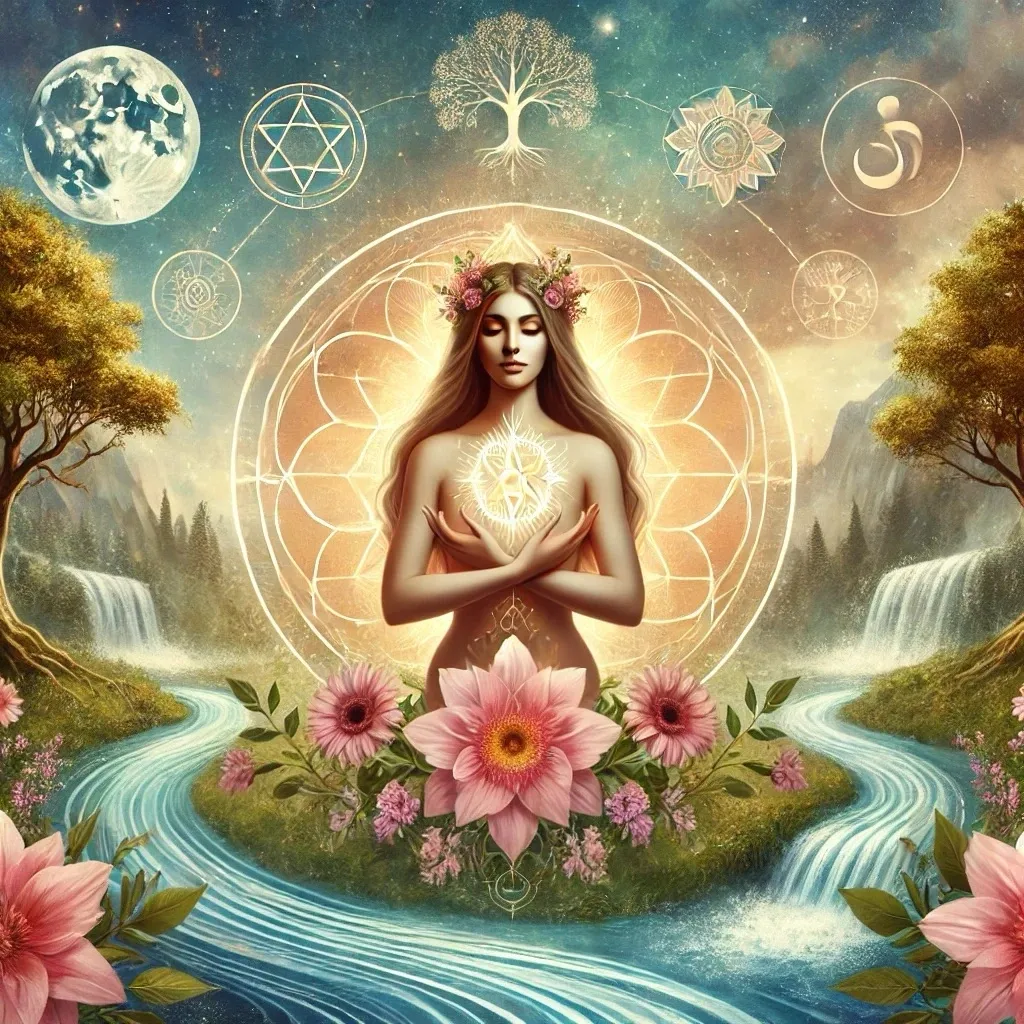
What if we imagined every penny had a sacred purpose and our job was to find out what that was and support it to flow on its way to what it’s meant to do. In nature there is no waste, trees don’t hoard, everything is either living or dying in its natural cycle. Mother Nature is abundance, and we are part of this nature.
What if there was no interest payable on debt? What if the inevitable cycle of the rich getting richer and the poor getting poorer was reversed?
What if we put down our obsession with owning stuff, realising that we are at best custodians of a beautiful garden that contains within everything we need to live at no cost?
What if the cycle of rampant materialism stopped being the driving force in the world, and we replaced GDP Gross Domestic Product with LFH Life Fulfilment & Happiness as our global metric and measure?
Ultimately what if there was no proxy, no money as an intermediary for life? what if we humans were life focused instead of money-first focused?
Everything we need already is, the ocean’s, the rivers, the land, the sky, the plants, the forests, the animals. What if we chose to live in deep gratitude of what we already have, honouring it and each other in the process? Offering our talents and gifts as a blessing to the world, taking only what we needed and giving back more than we take.
This is true abundance, and it is already here right now, available to all of us it we choose to see it.